
Artists should not be creative
Brief reflections over an excerpt from a famous David Sylvester interview

ENG VER BELOW
Già un paio di volte mi capita di vedere questo reel in cui il famoso critico e curatore David Sylvester (1924-2021) parla dei pericoli che incombono sulla creatività degli artisti.
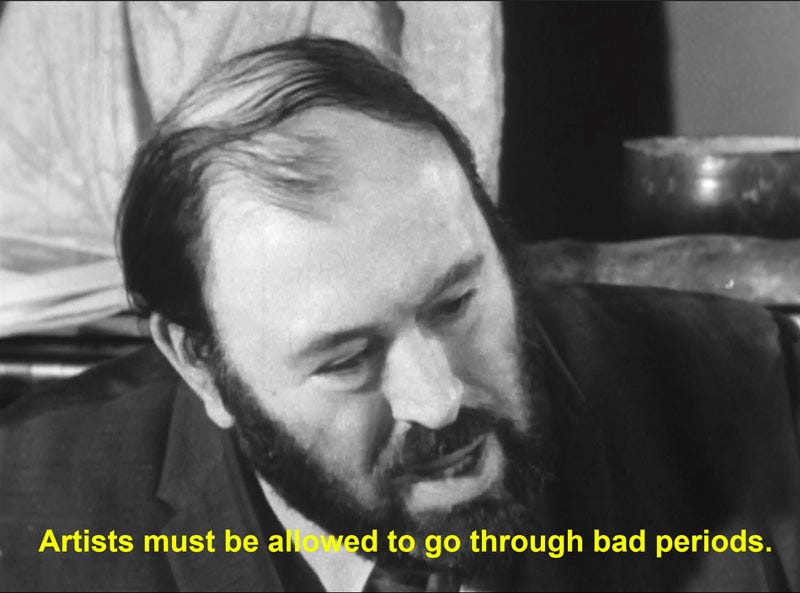
Ecco il video, la cui trascrizione recita:
”Artists must be allowed to go through bad periods! They must be allowed to do bad work! They must be allowed to get in a mess! They must be allowed to have dud experiments! They must also be allowed to have periods where they repeat themselves in a rather aimless, fruitless way before they can pick up and go on. The kind of attention that they get now, the kind of atmosphere of excitement which attends today the creation of works of art, the way that everything is done too much in the public eye, it’s really too much. The pressures are of a kind which are anti-creative.”
Questo breve paragrafo mi ha fatto pensare ad un paio di cose. Di primo acchito, è difficile dissentire con quanto afferma Sylvester. Attorno alla creazione artistica c’è un clima poco autentico, che fomenta la banalità.
Il problema è che è proprio il sottotesto culturale alla base di simili affermazioni a produrre il pericolo indicato.
Sylvester è noto nella storia dell’arte contemporanea inglese per aver coniato il termine kitchen sink, un’etichetta molto poco specifica, e per aver lavorato con artisti del calibro di Moore, Bacon e Freud, e curato mostre importanti. Wikipedia indica la giovanile conoscenza con Giacometti come influenza importantissima per la carriera del critico.
Non stupisce che un esperto d’arte nato e cresciuto all’inizio del secolo breve abbia perfettamente assimilato un pensiero che ponga l’artista come creativo par excellence, l’individuo che più di tutti si affida al pensiero laterale, irrazionale, differente, dissonante. Questa semplicistica riduzione dell’artista al ruolo di creativo è ovvia conseguenza della svolta romantica dell’arte e della filosofia europee, le quali elevarono l’individuo ad alpha e omega dell’epistemologia umana, sottolineandone, oltre all’assolutismo che ne caratterizza la presenza, l’impotenza a fronte di vari destini (naturali o sociali) nei quali si ritrova sballottato - l’individuo c’è, esiste, anzi tutto è individuale, però al contempo non può nemmeno fare altro che sottostare a leggi più grandi di lui, talvolta compiendo missioni prescrittegli altrove, da ascendenze dalle quali è incapace di staccarsi.
Seguendo questo indirizzo culturale, a cavallo tra i due secoli, l’artista iniziò quindi ad esprimere la propria individualità, fregandosene del contesto sociale in cui operava, affermando la propria autonomia: questo approccio produsse una teleologia per cui la novità del traguardo artistico raggiunto dal singolo, sempre e comunque in contrasto con ogni forma di precedente tradizione, diventa capitale per definire i meriti dell’opera. Oggi lo chiameremo hype; non è un caso che la storia dell’arte del novecento sia costellata da numerosi piccoli movimenti e nomi di singoli autori, più che da grosse correnti organiche e in lenta mutazione com’era solito avvenire sino praticamente al romanticismo stesso - in un mondo dove la nozione di individuo è enfatizzata a dismisura, collaborare ad uno scopo comune (sia esso anche solo estetico) diventa difficile.
In base a queste osservazioni pacifiche, mi sento di evidenziare la criticità delle affermazioni di Sylvester.
Gli artisti sono i veri creativi? La creatività dell’artista è qualcosa da difendere, o qualcosa che, in fondo, mette l’arte stessa e il suo ruolo nel mondo in pericolo?
Il singolo è in grado di sobbarcarsi completamente la responsabilità della creazione di discorsi in grado di tenere testa alle varie, complesse sfaccettature del presente?
Mi sembra evidente che non sia così.
Ogni artista, inevitabilmente, si ripete. Trasmuta continuamente quei pochi temi che si sono impressi a fuoco nella propria sensibilità. Anche i più ‘creativi’ si sono sempre, inevitabilmente ripetuti. Guardando ai grandi ispiratori della figura dell’artista come infinito profeta innovatore, Duchamp e Picasso, sono rinvenibili temi ripetuti e continuamente elaborati, e stiamo parlando di quei due che, probabilmente, nella storia dell’arte recente, si sono più permessi di variare stili e idee formali.
Gli artisti non possono fisiologicamente essere creativi puri, ma hanno bisogno di misurarsi col mondo esterno. Il lavoro dell’artista è sempre stato di mediazione e interpolazione con la realtà, pertanto è proprio la pretesa di univocità diffusa a uccidere ogni possibile vera diversità; nell’esprimere solamente sé stessi, vediamo come la produzione artistica si appiattisce inevitabilmente entro i soliti filoni formali e/o tematici: è la contraddizione della natura umana, per la quale siamo tutti diversi ma al contempo tutti uguali - nell’esprimere la propria unicità, si finisce per essere uguali al resto. Non è la creatività in quanto tale - cos’è poi, non l’ho mai capito - a definire l’artista, ma il suo ruolo all’interno del contesto sociale. La domanda giusta che Sylvester dovrebbe porsi, più che preoccuparsi (comunque giustamente, specialmente visti i tempi correnti) dell’esposizione sugli artisti, è se sia il caso di limitare il ruolo dell’artista a quello di un creativo da proteggere a prescindere dal valore aggiunto che produce in società.
La creatività è sempre sterile se distaccata da ambiti di applicazione precisi: arte è ancora la parola che, genericamente, indica qualunque tipo di pratica al suo massimo livello d’espressione. Ne desumiamo che l’imprenditore capace è un artista. Il medico competente è un artista. L’ingegnere in grado di migliorare l’urbanistica di un incrocio è un artista, così come il fisico o il matematico in grado di far progredire le proprie scienze. I pittori e scultori possono, eventualmente, essere artisti. Ma dovrebbero quantomeno tornare ad un contesto in cui la propria voce è messa al servizio di uno scopo più ampio della stupida, ombelicale espressione del sé - tutti gli altri professionisti menzionati, d’altronde, lavorano in questo modo. Solo all’artista è dispensata tale responsabilità, nel nome di un’espressione che poi, nei fatti, latita.
Brunelleschi costruì la cupola per la città di Firenze, per cercare di creare la più ganza cupola fino ad allora (e forse da allora) esistente, e lavorò per l’umanità tutta. Michelangelo affrescò la Sistina per la Chiesa e l’umanità tutta - nessuno di loro e dei loro colleghi, però, agivano sull’esclusiva base della loro egoriferita esigenza creativa, al contrario: i loro sforzi erano al servizio di sistemi di rappresentazione e necessità pratiche condivise, e guarda caso, questo approccio ha prodotto capolavori che quasi l’intera umanità riconosce come tali.
Il punto non è preservare la creatività degli artisti - tutti gli umani sono creativi - ma tornare a costruire un’idea di senso trasversale e condivisa, basata non più necessariamente su fantasie religiose o destini aleatori, ma sui fatti misurabili, la cui interpretazione permetta di identificare le nuove (vecchie) esigenze dell’umanità contemporanea.
In questo spazio di condivisione collettiva esiste una creatività utile, la creatività che serve ai più e non solo al singolo.
Un’artista che pensa solo a esprimere sé stesso non è più utile a nessuno.
Already a couple of times now I’ve come across this reel in which the well-known critic and curator David Sylvester (1924–2021) talks about the dangers that artists’ creativity faces.
Here’s the video, whose transcript reads:
“Artists must be allowed to go through bad periods! They must be allowed to do bad work! They must be allowed to get in a mess! They must be allowed to have dud experiments! They must also be allowed to have periods where they repeat themselves in a rather aimless, fruitless way before they can pick up and go on. The kind of attention that they get now, the kind of atmosphere of excitement which attends today the creation of works of art, the way that everything is done too much in the public eye, it’s really too much. The pressures are of a kind which are anti-creative.”
This short paragraph made me think about a couple of things. At first glance, it’s hard to disagree with what Sylvester says. The problem is that it is precisely the cultural context underlying such statements that produces the very danger he points out.
Sylvester is known in the history of contemporary British art for coining the term “kitchen sink,” a rather vague label, and for working with artists such as Moore, Bacon, and Freud, as well as curating important exhibitions. Wikipedia notes his early acquaintance with Giacometti as a major influence on his career as a critic.
It’s no surprise that an art expert born and raised at the beginning of the “short century” fully absorbed a way of thinking that places the artist as the creative figure par excellence — the individual who, more than anyone else, relies on lateral, irrational, different and dissonant thinking. This simplistic reduction of the artist to the role of “creative” is an obvious consequence of the Romantic turn in European art and philosophy, which elevated the individual to the alpha and omega of human epistemology. It emphasized not only the absolutism that characterizes individual existence, but also its powerlessness in the face of various (natural or social) destinies in which it finds itself tossed about — the individual exists, everything is individual, and yet at the same time it can do nothing but submit to forces greater than itself, sometimes fulfilling missions prescribed elsewhere by lineages from which it cannot detach.
Thus, around the turn of the century, artists begun to express their individuality, disregarding the social context in which they operated and asserting their autonomy. This approach produced a kind of teleology in which the novelty of the artistic achievement reached by the individual — always set against any prior tradition — becomes central in defining the value of the work. Today we would call this sort of thing ‘hype’. It is no coincidence that the history of twentieth-century art is filled with numerous, little movements and individual names, rather than large, organic currents evolving slowly, as was common until roughly the Romantic period itself: collaboration to common goals is difficult whenever the importance of individualism is overly stressed.
On the basis of these rather obvious points, I feel compelled to highlight the problematic nature of Sylvester’s statements.
Are artists creative among creative people? Is the artist’s creativity something to defend, or is it, in fact, something that ultimately puts art itself - and its goals - at risk?
Is the individual truly capable of fully bearing the responsibility of creating discourses able to confront the many complex facets of the present?
It seems evident to me that this is not the case.
Every artist, inevitably, repeats themselves. They continuously transform the few ideas that have been deeply impressed upon their sensibility. Even the most “creative” artists have always, inevitably, repeated themselves. Even looking at the great figures who inspired the idea of the artist as an endlessly innovative prophet—Duchamp and Picasso—we can find recurring themes that are constantly reworked. And those two were probably the artists in recent art history who allowed themselves the greatest degree of variation in style and formal ideas.
Artists cannot, in a physiological sense, be purely creative. It is precisely this expectation - present in Sylvester’s statement - that kills any real possibility of diversity: it reflects the contradiction of human nature, whereby we are all different and yet all the same. Therefore, it is not creativity as such — whatever that even means, I’ve never quite understood it — that defines the artist, but their role within a broader social context. The real question Sylvester should be asking, rather than worrying (albeit rightly, especially given current times), is whether it makes sense to limit the role of the artist to that of a “creative” to be protected regardless of the value they produce in society.
Creativity is always sterile when detached from specific fields of application. Once, the word “art” was a general term used to indicate any practice at its highest level of expression. A capable entrepreneur is an artist. A skilled doctor is an artist. An engineer able to innovate the design of an intersection is an artist, just as a physicist or mathematician capable of advancing their respective fields are artists. Painters and sculptors may, eventually, be artists — but they should at least return to a context in which their voice is placed at the service of a purpose greater than the foolish, self-centered expression of the self. Basically all kinds of pro just mentioned work this way, artists are the only ones dispensed from this responsability.
Brunelleschi built the dome for the city of Florence, to create the most magnificent dome ever since, and for all humanity. Michelangelo painted the Sistine Chapel for the Church, and for all humanity — none of them, nor their peers, acted solely on the basis of their own creative needs. On the contrary, creativity used to be at the service of shared systems of representation and practical necessities and, guess what, back then, it produced the most incredible masterpieces that almost all humanity recognizes as such.
The thirst for novelty, expressed in the very enclosed context of contemporary art is not, instead, creating anything culturally meaningful since what, decades? What kind of contemporary art as had any sort of influence outside its specific context of existence?
The point, then, is not to preserve the creativity of artists above others — all human beings are creative — but to recreate a shared, cross-cutting sense of purpose, based no longer on religious fantasies or arbitrary destinies, but on measurable facts whose interpretation allows us to identify the new (as well as old but still appropriate) needs of contemporary humanity.
In this tiny shared space lies the possibility of a kind of useful creativity, one that does serve many, and not only the singular person that exercises it.
An artist who only seeks to express themselves is no longer useful to anyone.